Your competitors are customizing their pet supply chain.
Are you?
✔ Impress your customers with tailored pet products

✔ Impress your customers with tailored pet products

Leave A Message — Our Sales Team Will Get Back To You Within 24 Hours With A Customized Offer.
How importers choose tofu cat litter packaging: pouch type, laminate structures, thickness, container loading, printing, and a pre-shipment QA checklist.
Quick answer: for export-grade tofu cat litter, the right bag is almost always a back-seal gusseted stand-up pouch in a laminated film structure (typically PET/PE or PET/AL/PE), 80–120 microns thick, with a load-bearing handle, a resealable zipper, and food-grade moisture barrier performance. It survives six weeks of humidity inside a shipping container, loads flat into cartons to protect your freight budget, and carries enough print quality to make a private label shelf-ready. Everything else — material choice, thickness, valve, zipper — follows from three questions: how long the goods are in transit, how they are retailed in your market, and what your brand needs the bag to say.
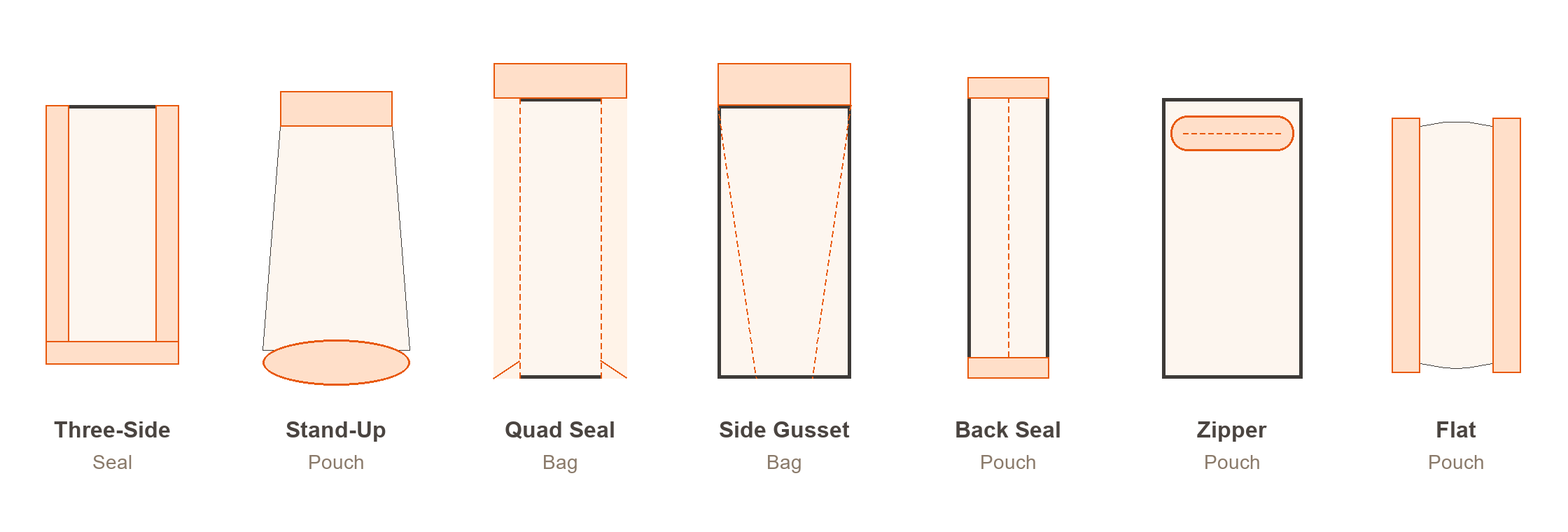
This guide is written for importers, distributors, and private label buyers sourcing tofu cat litter from China. We will walk through the pouch type that has become the market default, how to match material structure to your product and climate, the specs that decide whether a bag survives the journey, and the printing details that separate a generic import from a brand. If you are still comparing pouch geometries in general, our overview of the 7 types of flexible packaging pouches covers the full landscape; this article goes deeper on what actually works for tofu litter in a 6L export format.
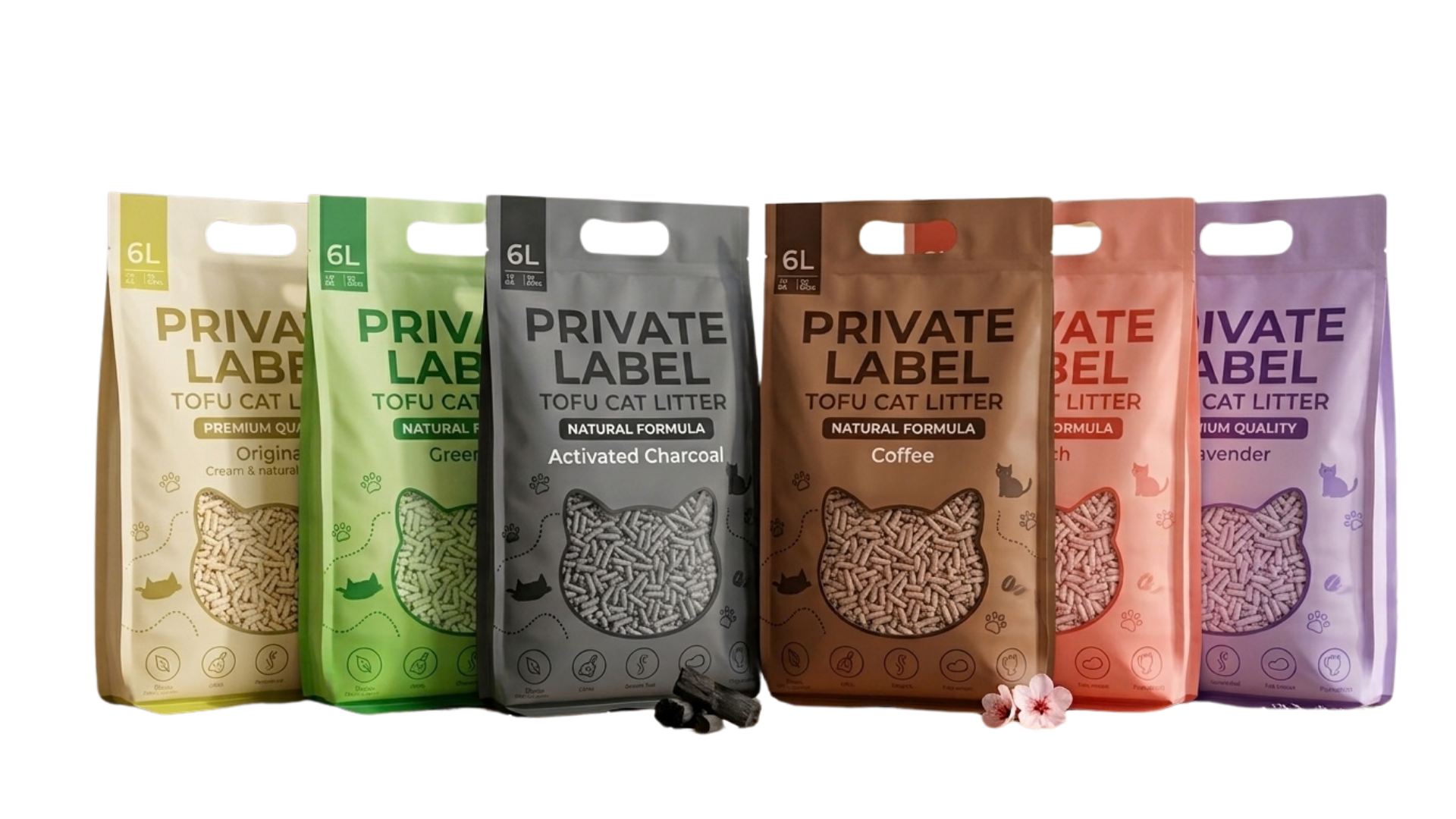
A domestic brand that ships pallets across one country treats the bag as a retail problem. An importer does not have that luxury. Your tofu cat litter will spend three to six weeks inside a metal container crossing the ocean, absorbing humidity swings from tropical ports to northern winters, then get stacked in a warehouse and shuffled onto retail shelves. The bag has to do three jobs at once: protect a hygroscopic, plant-based product from moisture, survive compression and handling without splitting, and still look sharp enough at the point of sale to justify the premium positioning tofu litter commands.
Get this wrong and the failure modes are expensive and unglamorous: litter arriving caked into solid blocks after absorbing container humidity, pallets rejected at the warehouse because three bags in a carton split at the bottom seam, or — the quiet killer — bags that look faded and cheap next to competitors on a retail shelf. Because tofu litter is plant-based (usually pea fiber, corn starch, and soy residue), it is noticeably more hygroscopic than mineral bentonite. Moisture is not a quality nitpick; it is the single most common cause of claims in this category.
The upside is that packaging is also one of the cheapest brand assets you control. Unlike freight rates or exchange rates, the bag is a decision you make once, per SKU, and it compounds across every order. If you are building the commercial case from scratch, our tofu cat litter buyers guide covers product-level specs; this article stays on the bag itself.
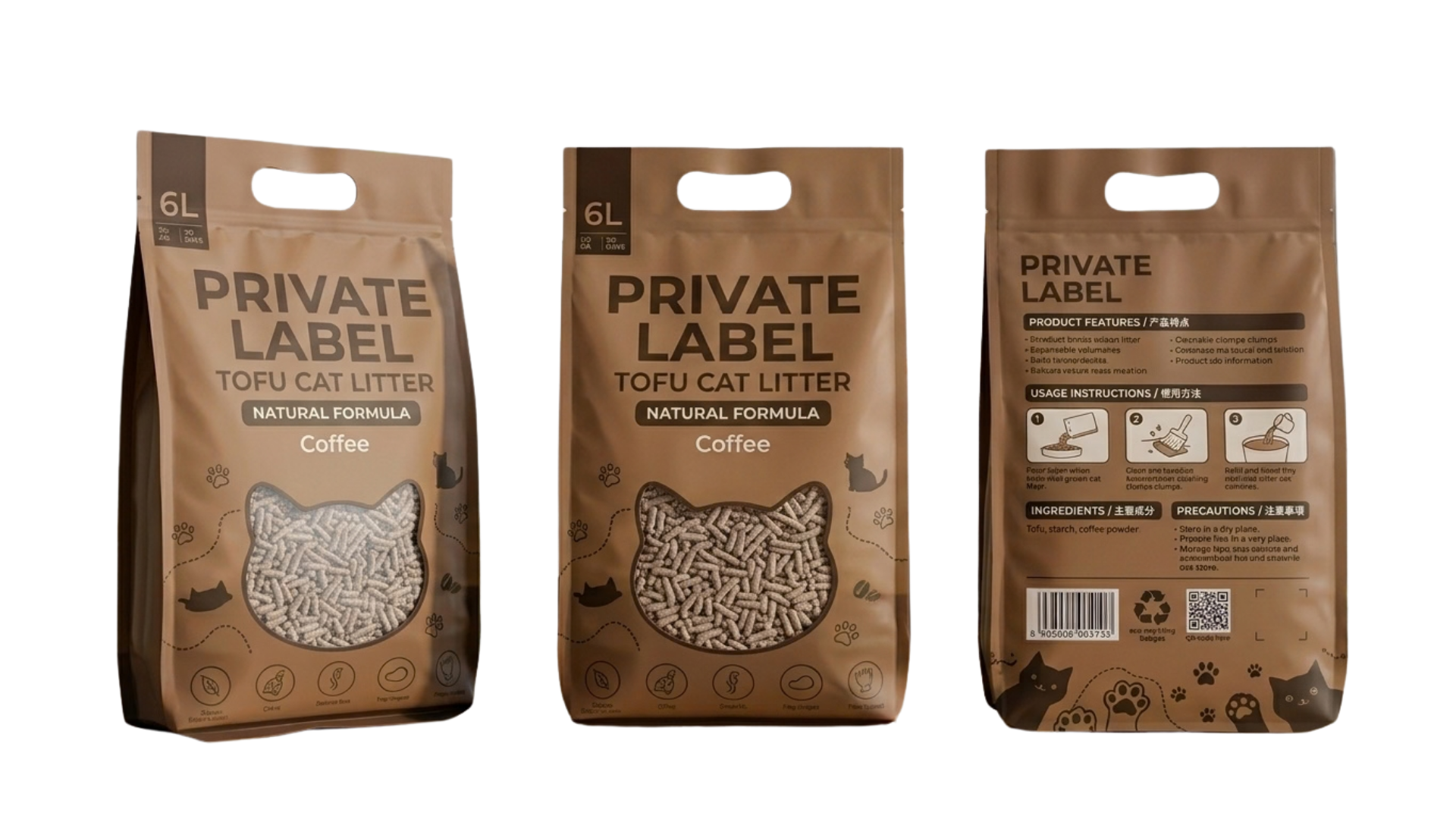
Spend any time comparing cat litter packaging across exporting factories and you will notice one format dominates: the back-seal gusseted stand-up pouch. It wins for reasons that line up almost perfectly with what an importer needs:
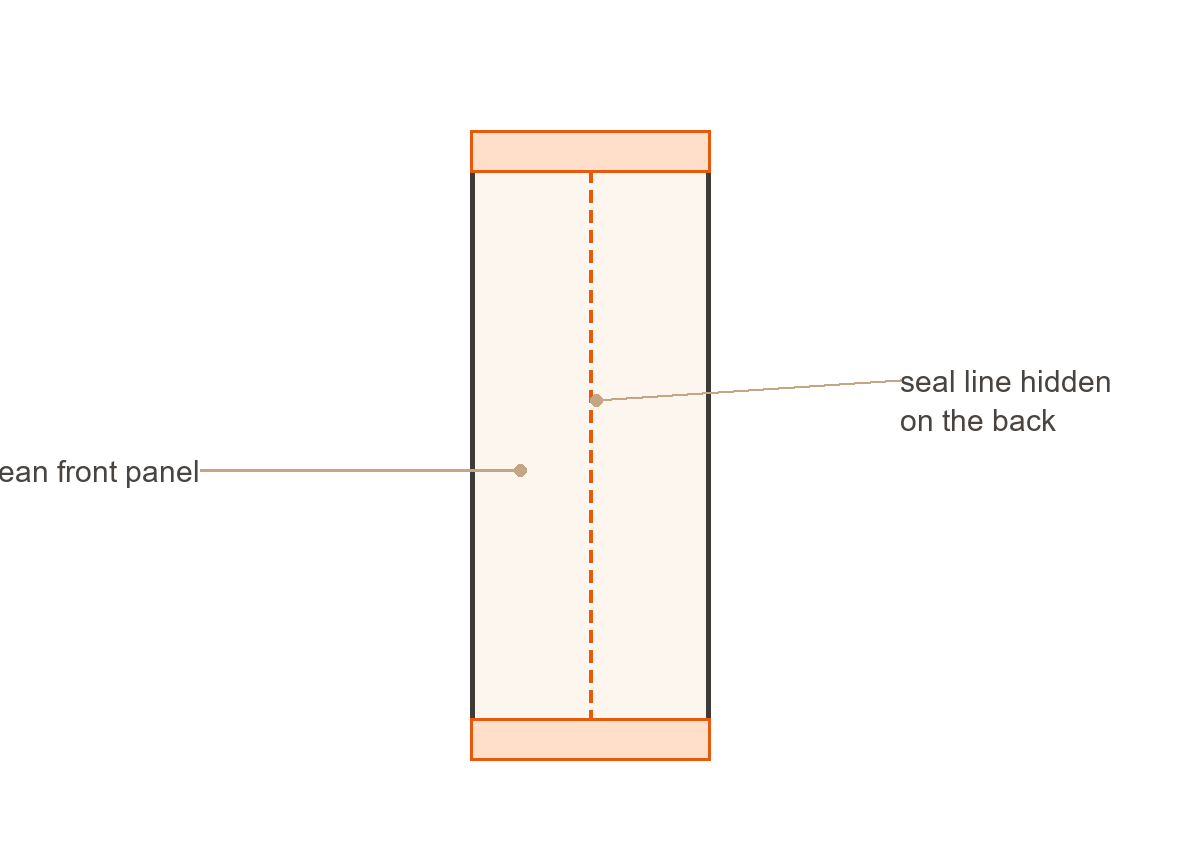
Other pouch geometries still have niche uses — a quad seal bag carries heavier weight with a more rectangular shelf presence, and flat pouches work for trial sizes — but for the core 6L export SKU, the back-seal gusseted stand-up pouch is where the industry has settled, and deviating from it usually requires a specific reason, not a general preference.
Tofu litter ships in two physical forms — granular and strip-shaped — and the strip form is bulkier for the same weight. That changes your pouch math: a 6L bag suits roughly 2.4–2.6 kg of granular litter, but strip-shaped litter of the same weight needs closer to 7L of internal volume. Buyers who spec bags by weight alone end up with overstuffed pouches whose gussets burst at the side seams during compression testing. Spec by volume, then verify with a filled, sealed, and dropped sample.
| Format | Typical Fill | Best Use | Notes for Importers |
|---|---|---|---|
| 2L stand-up pouch | ≈0.8–1.0 kg | Trial size, e-commerce multipacks | Low entry price; great for first orders and sampling programs |
| 6L stand-up pouch with handle | ≈2.4–2.6 kg | Core retail SKU | The market default; handle is effectively mandatory in Western retail |
| 7–8L stand-up pouch | ≈2.5 kg strip-shaped | Strip-formula premium lines | Check gusset width; strip litter needs the extra volume |
| 10–12L pouch or small sack | ≈5 kg | Value packs, club stores | Confirm bottom-seal strength; consider twin handles |
If your range will cover several flavors, keep one pouch geometry across all of them and differentiate by print color only. Identical dimensions mean one set of carton sizes, one pallet pattern, and simpler warehouse handling on your side — while the shelf still reads as a full branded family. Entry price points can run the same geometry in the two-layer structure — the setup behind lines such as our standard tofu cat litter — while premium SKUs justify the foil upgrade. That is exactly how our premium tofu cat litter range is packaged: same 6L pouch, different colorway per scent, including ocean breeze and activated charcoal variants for odor-control-focused buyers.
The film laminate decides how well the bag blocks moisture, how it prints, what it costs, and what sustainability story it can tell. These are the four structures you will actually be quoted:
| Structure | Moisture Barrier | Print Quality | Relative Cost | Best For |
|---|---|---|---|---|
| PET/PE (two-layer laminate) | Good — adequate for most retail cycles | High (surface PET layer) | Lowest | Standard retail SKUs, price-driven markets |
| PET/AL/PE (with aluminum foil) | Excellent — near-zero moisture transmission | High, with premium metallic sheen option | Medium | Long transit, tropical/humid climates, premium positioning |
| Kraft paper/PE | Moderate — depends heavily on PE thickness | Medium; natural matte look | Medium | Natural/organic brand stories, boutique retail |
| Recyclable mono-material PE/PP | Good and improving with new barrier coatings | High | Medium-high | Markets with EPR rules or strong eco positioning |
Two practical notes. First, aluminum foil laminate is the underrated choice for sea freight: the incremental cost per bag is small, and it removes most of the humidity risk that comes with a five-week voyage into a tropical port. If your market is Southeast Asia, the Gulf, or a humid coastal region, ask for PET/AL/PE quotes before settling for PET/PE. Second, mono-material recyclable structures are moving fast and now perform close to conventional laminates — relevant if you sell into EU markets where packaging regulations are tightening, and a natural fit for eco-positioned lines like our ultra-premium eco-friendly tofu cat litter. Our guide to custom packaging for pet products covers how these choices interact with branding and minimum order quantities.
Thickness is where spec sheets get casually wrong. For a 6L filled pouch, 80–120 microns total laminate thickness is the working range; below about 80 microns the bag starts denting and puncturing on pallet corners, and above about 120 you are paying for stiffness nobody needs. What matters more than the raw number is how the structure is verified:
One container-specific hazard deserves its own paragraph: condensation. Containers crossing the equator routinely cycle through dew points that rain moisture onto carton surfaces from the inside. Bags with a foil layer and a well-sealed zipper shrug this off; thin PET/PE bags in kraft cartons can arrive with visibly caked product. Desiccant packs and container liners help, but they are patches — the laminate is the cure. This is why we treat the material table above as a routing decision, not just a cost decision.
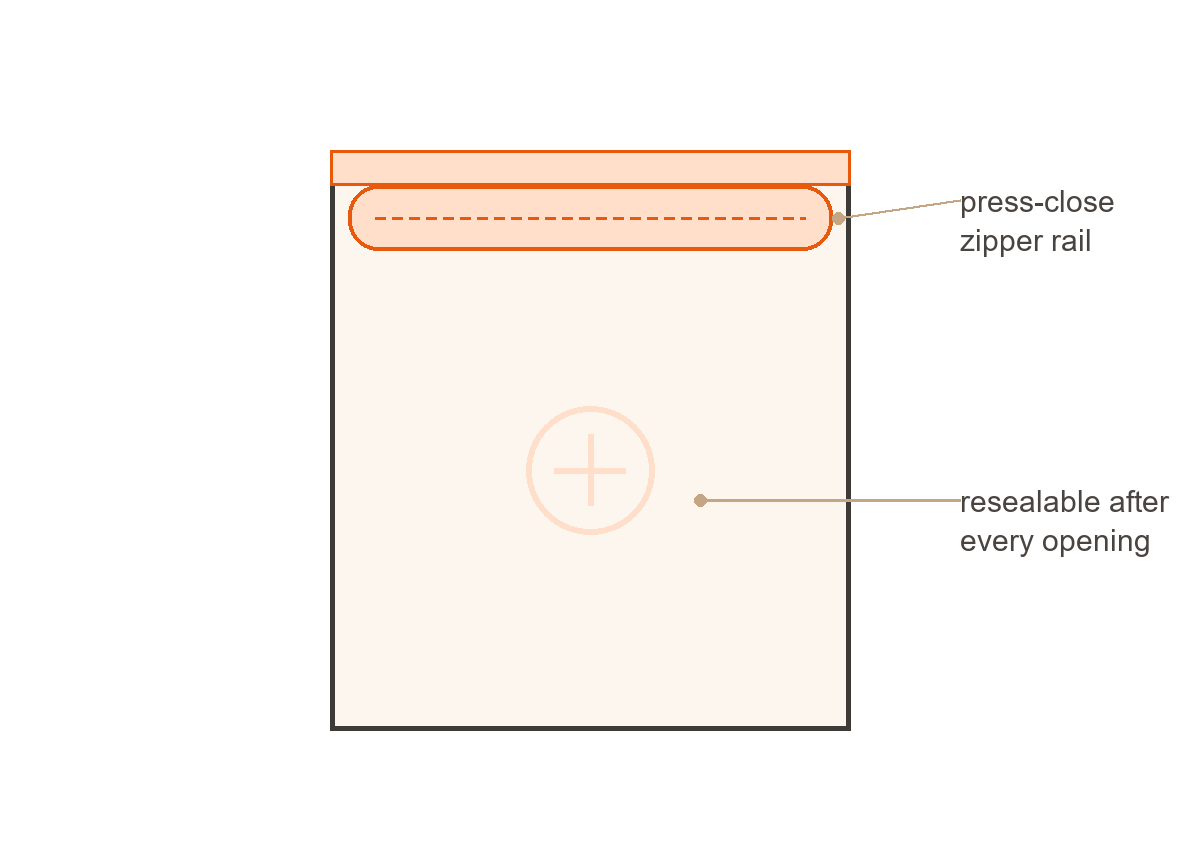
Flexible pouches have a freight advantage that rigid packaging cannot match: they pack flat before filling and nest into cartons with almost no trapped air. In practice, a 40-foot high-cube container of 6L pouches in cartons typically lands around 18–20 tonnes of tofu litter — close to the practical payload ceiling — whereas the same weight in rigid jugs or tubs would cube out the container well before weighing out. For a mid-volume importer, that difference is measured in thousands of dollars per container.
Design choices that protect this advantage: keep pouch dimensions consistent across flavors (one carton size, one pallet pattern); avoid odd-shaped spouts or rigid fitments that waste carton volume; and confirm the filled carton’s external dimensions divide evenly into your pallet plan. A bag that is 15 mm too wide can cost you a carton layer per pallet, which multiplies across a full container into real money. When you evaluate quotes from different factories, compare the carton dimensions and calculated container loading plans, not just the per-bag price — the cheapest bag is occasionally the most expensive shipment.
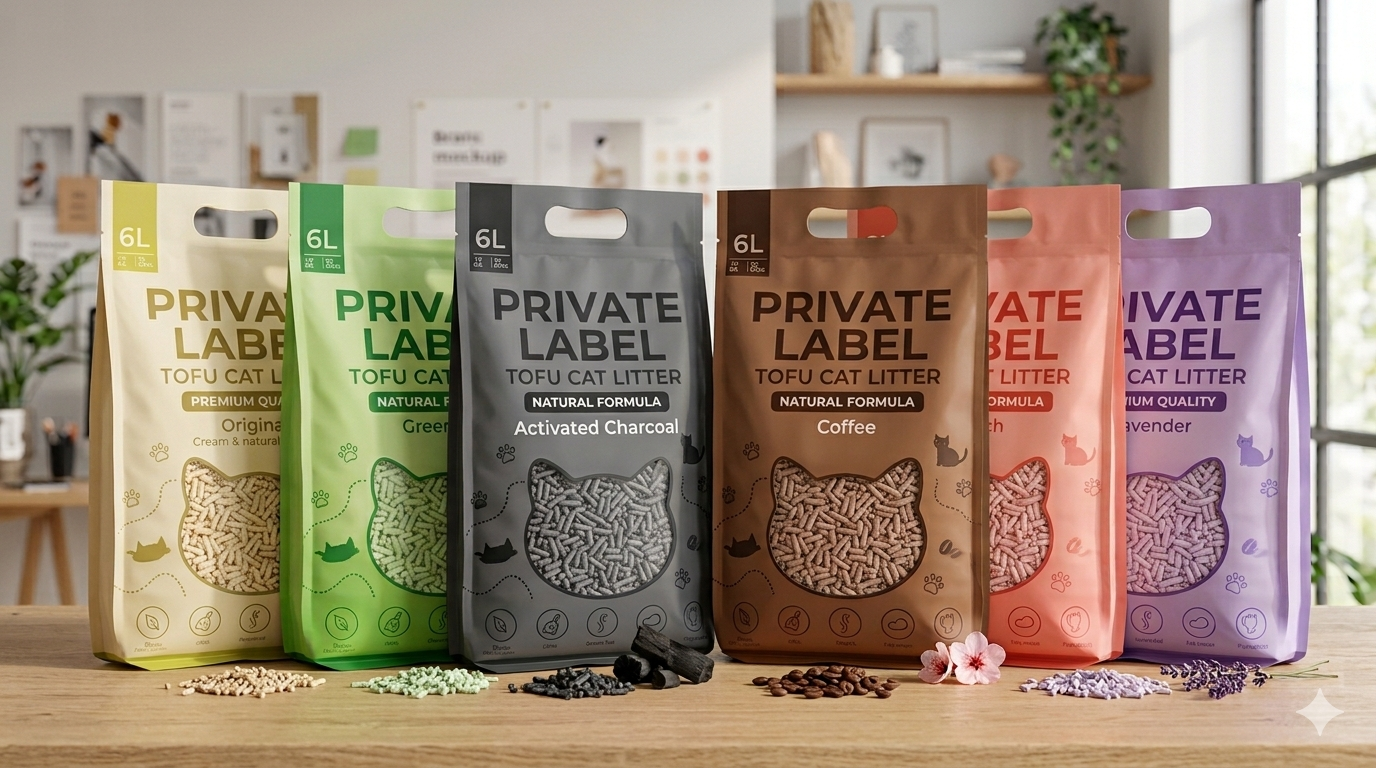
For most importers the bag is the brand, because it is the only part of your product the end customer ever touches. A few essentials worth knowing before you approve artwork:
If you are launching a brand rather than buying for distribution, our private label cat litter page explains how packaging development fits into the OEM process, and this walkthrough on building your own pet brand covers the commercial sequence end to end.
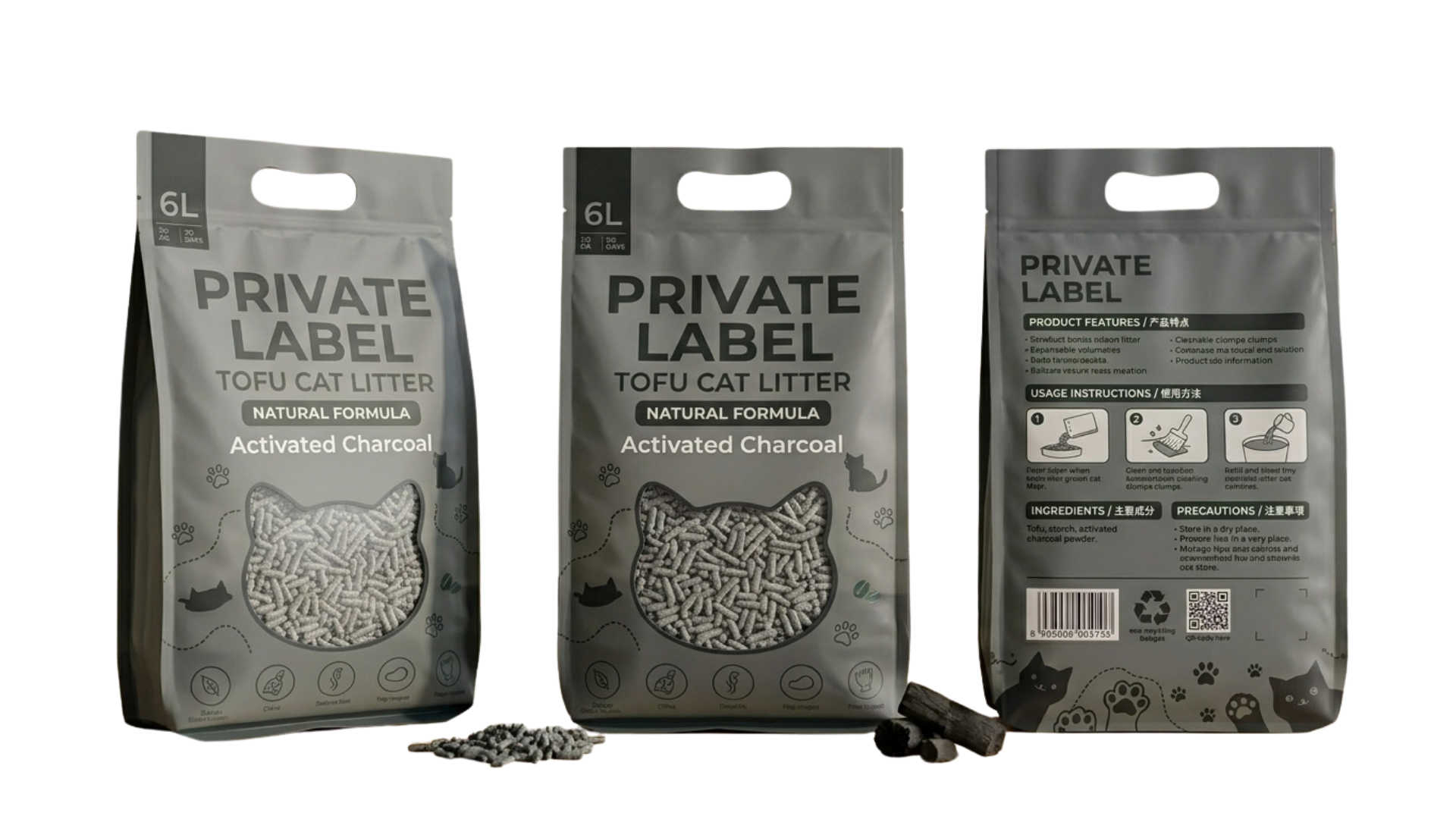
Print this list and hand it to whoever runs your inspection. Every item is cheap to check at the factory and expensive to discover at your warehouse:
None of this is exotic. It is the difference between a supplier who runs a disciplined packaging line and one who treats bags as an afterthought — and the checklist makes the difference visible before you pay the balance.
A back-seal gusseted stand-up pouch in a PET/PE or PET/AL/PE laminate, 80–120 microns thick, with a handle and resealable zipper. It is the market default because it combines a full moisture barrier, flat shipping, shelf-ready presentation, and full-bleed custom printing in one format.
Not always, but for long sea transit or humid destination climates it is the safest choice. Foil reduces moisture transmission to nearly zero; a two-layer PET/PE bag relies on its PE layer, which is good but not impermeable. For premium SKUs and tropical markets, the small extra cost per bag is cheap insurance.
The working range is 80–120 microns of total laminate thickness. Below 80 microns, puncture and dent risk rises on pallet corners; above 120 microns you pay for stiffness without a real benefit. Verify with a filled drop test rather than trusting the number alone.
With rotogravure printing, economics typically start around 5,000 bags per design because of cylinder costs; many factories will quote lower with a cylinder surcharge. Digital printing removes the cylinder requirement entirely and suits first orders and short runs at a higher unit price. Ask both ways and compare landed cost.
Conventional multi-layer laminates (PET bonded to PE or foil) are not accepted by most curbside recycling programs. Recyclable mono-material PE/PP pouches with barrier coatings are the practical answer and perform close to conventional structures; they are worth specifying for EU markets and any brand with a sustainability position.
A 40-foot high-cube container typically carries 18–27 tonnes of bagged tofu cat litter, depending on carton dimensions and pallet pattern. Because pouches pack flat and nest tightly, flexible packaging usually reaches the payload limit before it cubes out — which is precisely the freight advantage over rigid containers. Insist on a written loading plan with your quote.
Choosing the bag is a one-time decision that compounds across every container you ship. If you are comparing suppliers, ask for filled samples of the actual pouch — not renderings — and run the checklist above on them before you commit. The bag that survives the journey and sells on the shelf is out there; it just needs to be specified deliberately.
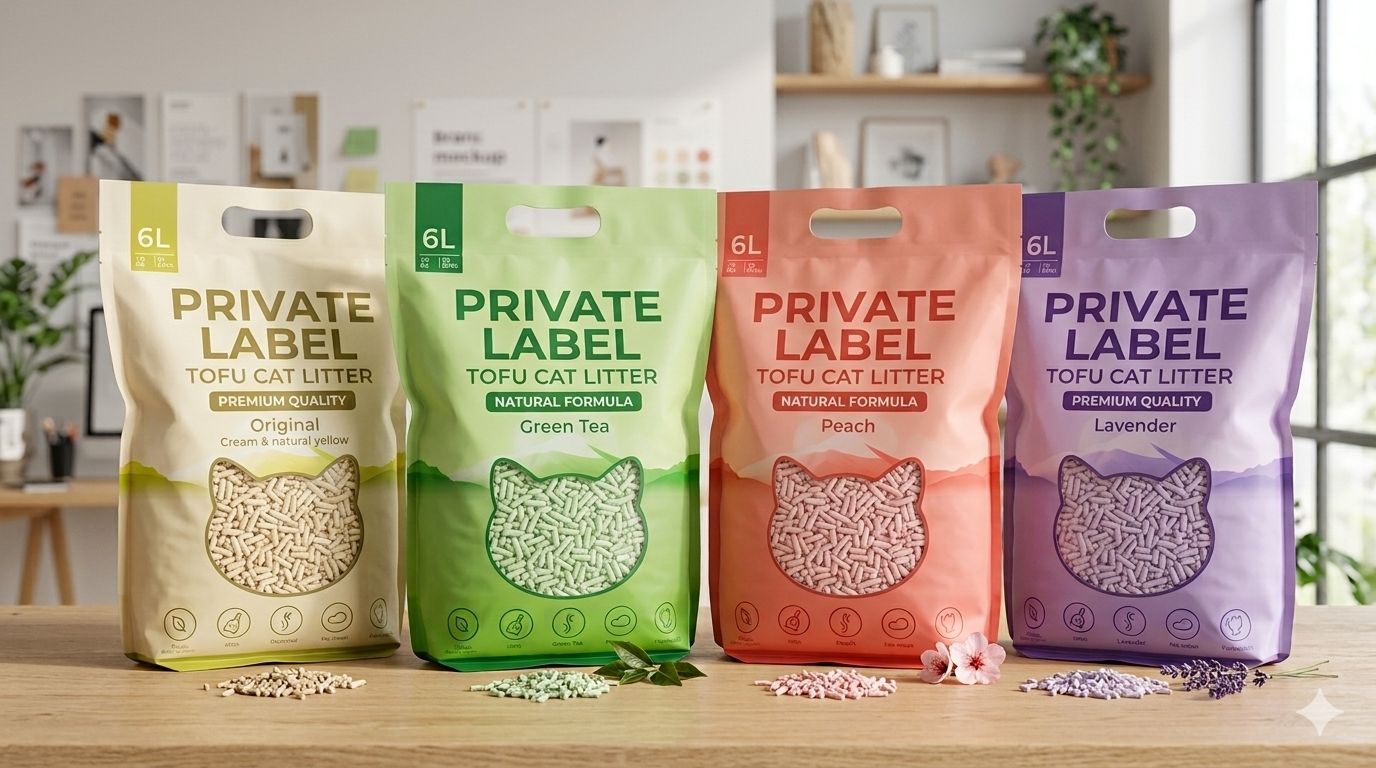
Ready to spec packaging for your own tofu cat litter range? Send us your target market and flavor plan, and we will recommend the pouch structure, thickness, and print setup that fits it.
Tell us what you are planning and we will come back with packaging options, samples, and a container loading plan.


Get Started
Featured Products
Animals We Serve
Wholesale
Resource
Work With Us